Predicting plasmids
This section will cover:
Are there plasmids in Vibrio cholerae?
Plasmids can be an interesting and important feature of Vibrio cholerae genomes, particularly because antibiotic resistance genes are carried by IncC/A-type plasmids in some isolates from the current pandemic lineage (7PET). For example, the multi-drug resistant (MDR) phenotype seen in V. cholerae in Yemen, starting in 2019, was due to spread of an IncC-type plasmid carrying antibiotic resistance genes (Lassalle et al 2022). Therefore, understanding of evolution and spread of plasmids and other mobile elements in V. cholerae, particularly in the current pandemic lineage (7PET lineage) is an important topic of research.
Many plasmids have been identified in environmental isolates of Vibrio cholerae (note that most of these isolates probably do not belong to the current pandemic lineage), as well as in isolates of the current pandemic lineage (7PET lineage) (see De et al 2021). Some of these V. cholerae plasmids have been given names (e.g. ‘pVC1’, ‘pVC2’, ‘pSDH-1’, ‘pSDH-2’, ‘p3iANG’, etc.). Some of the classes of plasmids seen in V. cholerae are ColE1-like plasmids and Inc-A/C family plasmids (De et al 2021).
Predicting plasmids in your isolate
If you learn better by seeing rather than reading, see the video on predicting plasmids in H22, using Vibriowatch, for an example using the assembly of the isolate H22 collected in Haiti in 2022, which was sequenced by Rubin et al 2022.
Vibriowatch uses the IncTyper tool to identify plasmids in Vibrio cholerae genomes. If no plasmids are predicted in the genome of an isolate, you will see this in the ‘Plasmid Inc types’ section of its report page:

An example of an isolate with a predicted plasmid is RC9, which was isolated in Kenya in 1985. Here is the ‘Plasmid Inc types’ section of its report page in Vibriowatch:
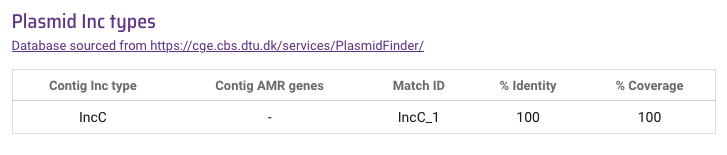
This shows that this isolate is predicted by Vibriowatch to have a IncC-type plasmid.
CholeraBook
If you would like to learn more about cholera genomics, you may also be interested in our Online Cholera Genomics Course (CholeraBook).
Contact
I will be grateful if you will send me (Avril Coghlan) corrections or suggestions for improvements to my email address alc@sanger.ac.uk