Predicting virulence genes
This section will cover:
Short guide for those in a hurry: is my isolate predicted to produce cholera toxin?.
Displaying virulence gene presence/absence on the tree for a collection of isolates.
Short guide for those in a hurry: is my isolate predicted to produce cholera toxin?
Cholera toxin (CT) is a toxin usually produced by Vibrio cholerae of the current pandemic lineage (7PET lineage), and is a protein that induces profuse, watery diarrhoea.
Cholera toxin is encoded by the ctxA and ctxB genes.
A quick way to find out whether your isolate likely expresses cholera toxin is to look at the predicted virulence genes for your isolate in Vibriowatch.
Once you have sequencing reads or a genome assembly for your isolate to Vibriowatch (see Is my isolate Vibrio cholerae?), Vibriowatch will display a piechart showing the species of your isolates are, e.g.:
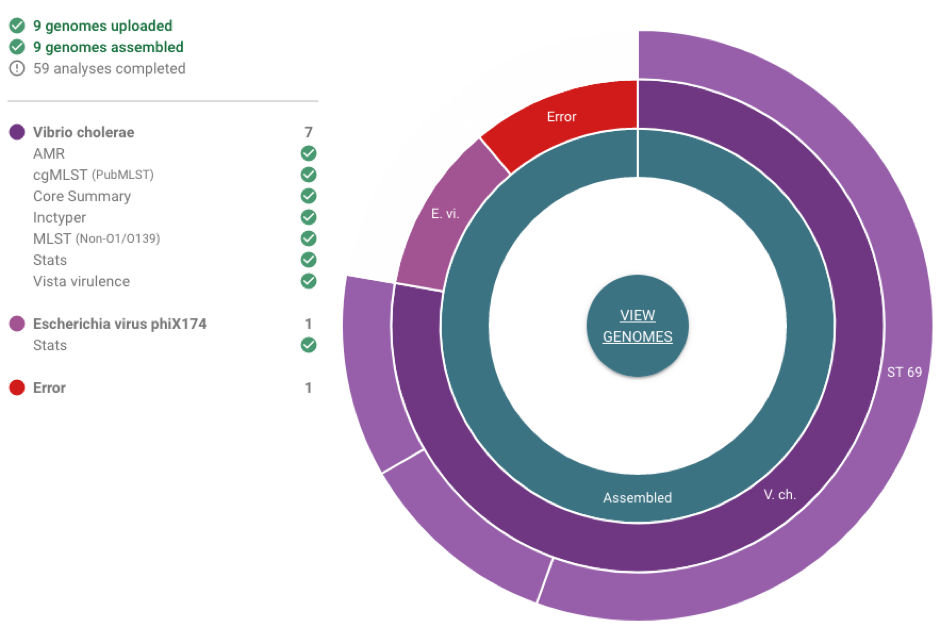
To view the report pages for your isolates, which will tell you their predicted virulence genes, you need to click on the ‘View genomes’ link in the middle of the piechart.
This will bring up a list of your isolates in Vibriowatch, looking something like this:
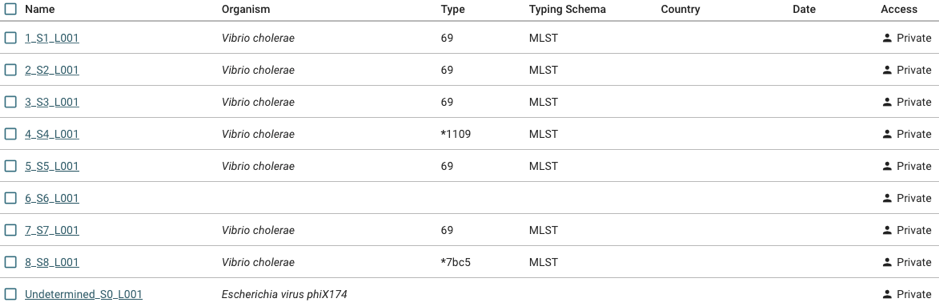
To go to the report page for a particular isolate, click on the link on the left in the ‘Name’ column, e.g. ‘1_S1_L001’.
If you learn better by seeing rather than reading, see the video on predicting if H22 produces cholera toxin, using Vibriowatch, for an example using the assembly of the isolate H22 collected in Haiti in 2022, which was sequenced by Rubin et al 2022.
If you scroll down the ‘report page’ for your isolate (or the report page for any isolate, you will find a section with the heading ‘Virulence Genes’.
For example, here is ‘Virulence Genes’ part of the report page for an isolate HCUF-01:
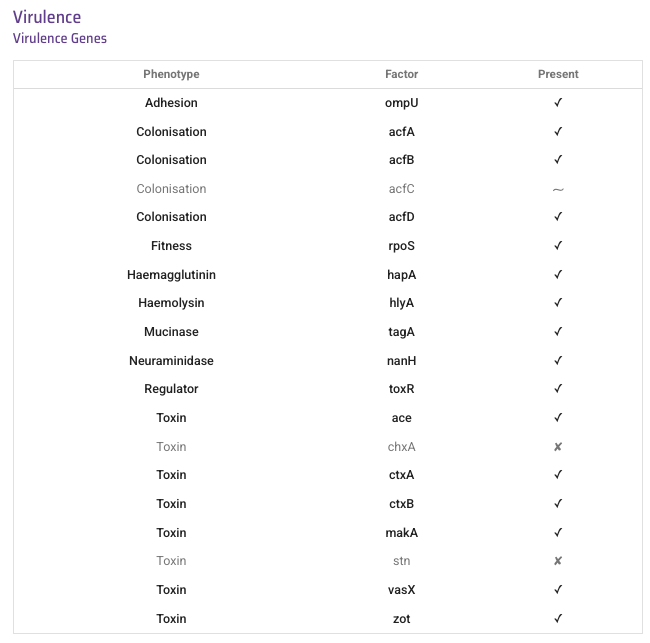
The tick next to ‘ctxA’ shows that the cholera toxin gene ctxA is present, while the tick next to ‘ctxB’ shows that the second cholera toxin gene ctxB is present. These two genes encode the CtxA and CtxB subunits of the cholera toxin protein. Because this isolate probably has ctxA and ctxB, it probably produces cholera toxin, so will give rise to severe cholera.
Sometimes you may see a ‘~’ symbol beside ‘ctxB’, indicating that there was a partial match to the ctxB gene. This could either mean that the ctxB gene is truncated in this isolate, or that there are one or more SNPs in ctxB in this isolate. The ctxB gene is known to have several circulating SNPs in the V. cholerae species (see Lee et al 2021).
If an isolate lacks the ctxA and ctxB genes, it is predicted to not produce cholera toxin and as a result will not cause severe cholera, probably only relatively mild diarrhoea.
If you found this useful, you may want to read through the rest of the tutorial to find out more details.
Predicting additional virulence genes in your isolate
It is well described that certain ‘virulence genes’ can make Vibrio cholerae more virulent, causing more severe disease (see Ramamurthy et al 2020 for a review of virulence in V. cholerae). The most important virulence genes for V. cholerae are the ctxA and ctxB genes, which encode the cholera toxin (CT) and also the tcpA gene which encodes the toxin co-regulated pilus (TCP), which is important for colonisation of the host. Cholera toxin disrupts the normal ion transport in the gut epithelium, causing massive water influx into the intestine, which leads to severe diarrhoea. The ctxA and ctxB and tcpA genes are common in isolates belonging to the current pandemic lineage (7PET lineage), but are occasionally found in isolates of other lineages too.
As well as ctxA, ctxB, and tcpA, V. cholerae isolates can also have some other virulence genes of lesser importance, such as additonal toxin genes zot, ace, hlyA, makA, rtxA, chxA, vasX, and stn.
Vibriowatch uses a tool called ‘VISTA’, based on BLAST, to identify virulence genes in V. cholerae genomes. Let’s look again at the section of the report page on ‘Virulence Genes’ for isolate HCUF-01:
The ticks show that this isolate has the intestinal colonisation genes ompU, acfA, acfB, acfC and acfD; virulence regulatory gene toxR; sigma factor gene rpoS; mucinase tagA; haemagglutinin hapA; neuraminidase/sialidase nanH; and toxin genes ctxA, hlyA, toxR, ace, makA, zot, and vasX. The genes hlyA, toxR, ace, makA, zot, and vasX encode toxins that are not as potent as that encoded by ctxA and ctxB, ie. these toxins do not cause very severe diarrhoea. We see a ‘~’ symbol beside ‘acfC’, which means that the acfC gene may be partial or contain SNPs.
The sigma factor gene rpoS has many roles, but is part of a large regulatory network involved in regulating virulence in V. cholerae (see Dorman and Dorman 2018).
Here is an example of the virulence section of the report page from another isolate, isolate GXFL1-4, which was isolated from prawns by Zhou et al 2022:
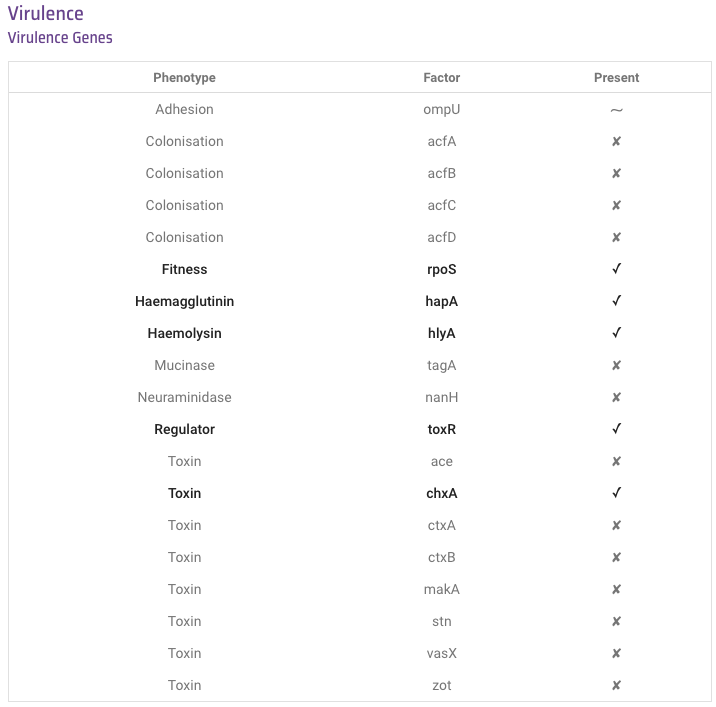
It’s interesting to note that this isolate, which does not belong to the current pandemic lineage (7PET lineage), is missing thecholera toxin genes, ctxA and ctxB. Interestingly, this isolate is predicted to have the cholix toxin gene, chxA, which is rare in the current pandemic lineage (7PET lineage) but may perhaps be important to interactions between V. cholerae and crustaceans (see Jorgensen et al 2008).
Predicting virulence clusters in your isolate
Below the Virulence gene list, there are also some virulence gene clusters listed, such as the TCP cluster, which includes genes tcpABCDEFHIJNQRST; the Lux operon, which includes genes luxOPQSU; the RTX operon, which includes rtxABCD; and the MSHA pilus operon, which includes mshABCDEFGHIJKMN. For example, here is the ‘Virulence clusters’ section for isolate HCUF-01:
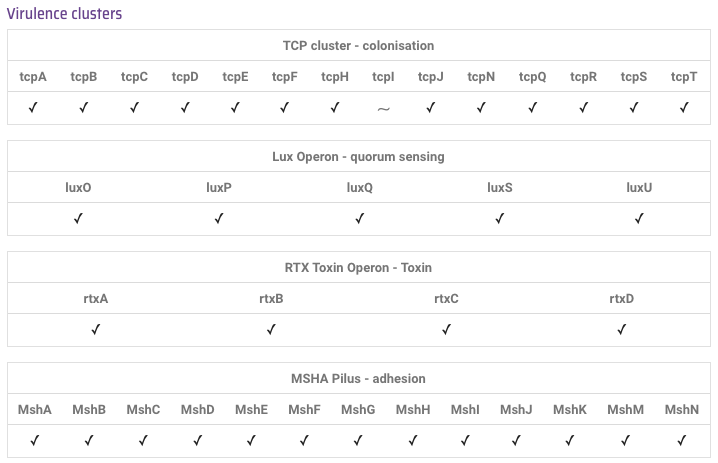
The TCP cluster contains the important virulence gene tcpA, which is key for colonisation of the human host. The TCP cluster is part of the ‘Vibrio Pathogenicity Island-1’ (VPI-1), a genomic island often found in isolates of V. cholerae that belong to the current pandemic lineage (7PET lineage). tcpA is a key virulence factor for intestinal adherence/colonisation, and if an isolate lacks tcpA, it likely will not cause severe cholera, probably only relatively mild diarrhoea. The TCP cluster also contains the key virulence regulator toxT (also known as tcpN). In the case of the ‘Virulence clusters’ section for isolate HCUF-01, we see a ‘~’ symbol beside ‘tcpI’, which means that the tcpI gene may be partial or contain SNPs.
The RTX operon rtxABCD includes gene rtxA, which encodes a toxin known as ‘repeats-in-toxin’.
The MSH operon includes the key gene mshA, which encodes the key structural unit of the MSHA pilus. The role of the MSHA pilus in virulence is possibly indirect. The MSHA pilus is involved in attachment to biofilms and surfaces, and is likely important for V. cholerae to form biofilm on some surfaces in the environment (see Watnick et al 1999). Furthermore, ingesting water containing V. cholerae biofilms may enhance acute cholera infection, for example, based on evidence from infant mouse models of cholera (see Tamayo et al 2010).
The Lux operon of Vibrio cholerae is involved in luminescence (see Grim et al 2008), and is also part of a large regulatory network involved in regulating virulence in V. cholerae (see Dorman and Dorman 2018).
As another example, here is the section on virulence clusters for isolate GXFL1-4, which was collected from prawns by Zhou et al 2022:
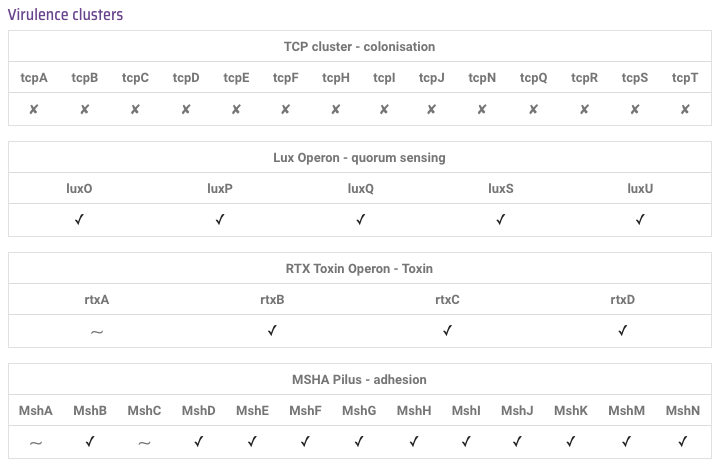
This isolate is missing the key virulence gene tcpA. Thus, it is missing the key genes necessary for virulence in human hosts, ctxA and ctxB (see above), and tcpA. Therefore, it would be very unlikely to cause severe cholera in humans, and would probably only produce mild diarrhoea.
Displaying virulence gene presence/absence on the tree for a collection of isolates
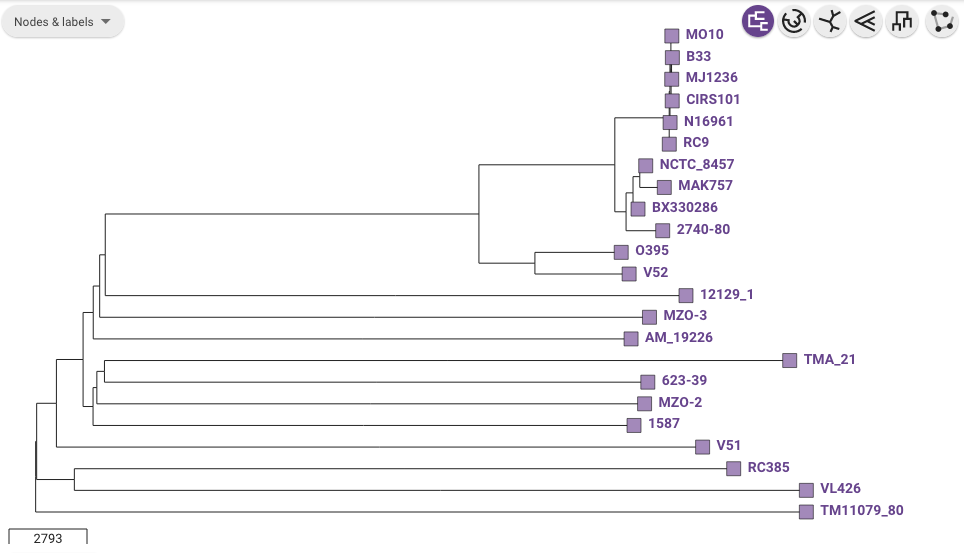
If you make a collection of isolates in Vibriowatch, you can display the presence/absence of a particular virulence gene (e.g. ctxA) beside the tree.
For example, if you look at the public Vibriowatch collection for the paper by Chun et al 2009 (see here for the paper in PubMed), if you turn on the leaf labels you will see a picture of the tree with the isolate names beside the tips of the tree:
To show virulence gene presence/absence beside the tree, click on the ‘Timeline’ menu below the tree, and choose ‘Virulence’ instead of ‘Timeline’. Then click on the column heading ‘ctxA’ to show the presence/absence of the ctxA gene and you should see the nodes of the tree light up as red if they have the ctxA gene, orange if they have a partial match to the ctxA gene, and colourless if they don’t have a match to ctxA:
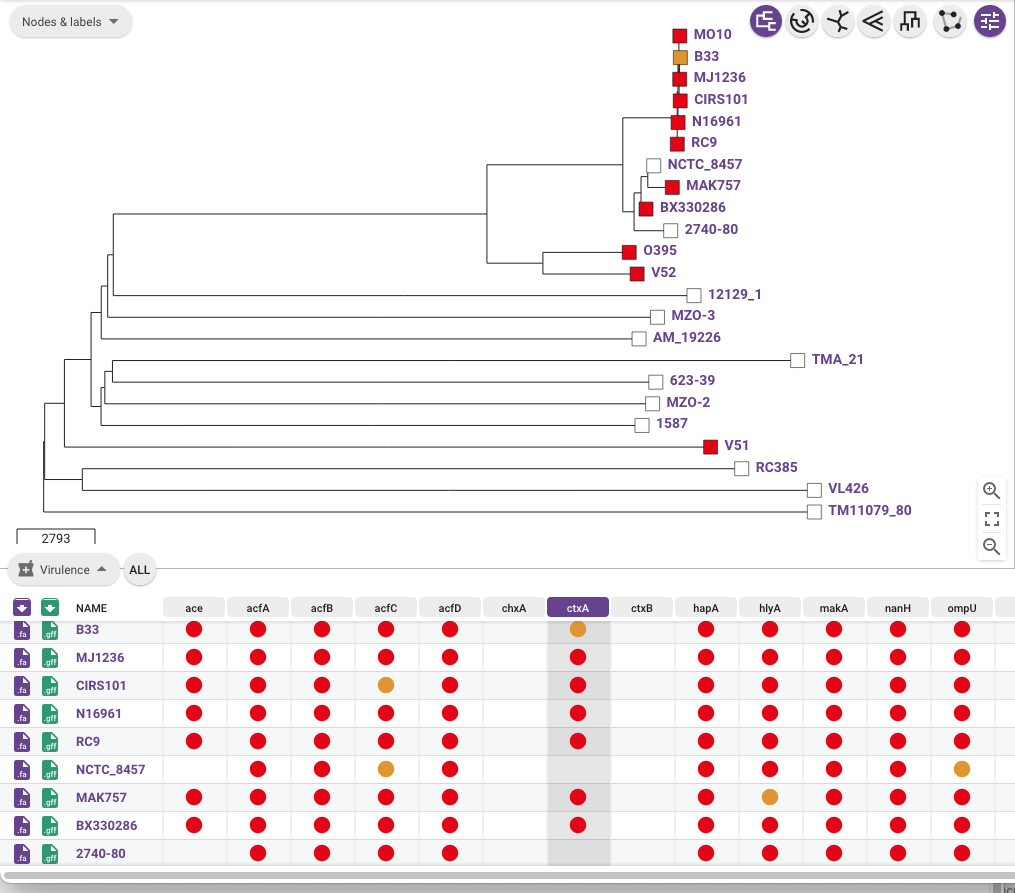
We can see that the ctxA gene, which encodes part of the cholera toxin, is present (or found at least partially) in the isolates in the current pandemic lineage (7PET lineage), i.e. isolates M010, B33, MJ1236, CIRS101, N16961, and RC9; as well as in some closely related ‘pre-7PET’ lineage isolates (isolates MAK757 and BX330286). However, interestingly, the ctxA is also present too in some isolates that are not in current pandemic lineage (7PET lineage), such as the isolates V52 and O395. Indeed, some isolates such as V52 that do not belong to the current pandemic lineage have been found to produce cholera toxin.
CholeraBook
If you would like to learn more about cholera genomics, you may also be interested in our Online Cholera Genomics Course (CholeraBook).
Contact
I will be grateful if you will send me (Avril Coghlan) corrections or suggestions for improvements to my email address alc@sanger.ac.uk